
I’ve always enjoyed watching the leaves change in the fall. One day, the trees are full of green leaves. A few weeks later, there are shades of orange, yellow, and red everywhere. Then those same leaves are scattered across the ground. When that happens, we tend to focus on what the trees are losing…leaves and color. Yet those same leaves become part of the soil, returning nutrients to the ground and helping protect what is still growing.
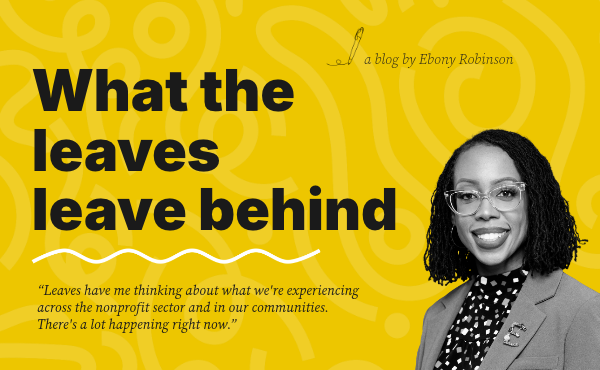
Leaves have me thinking about what we’re experiencing across the nonprofit sector and in our communities. There’s a lot happening right now.
Funding is uncertain for many organizations. Families are facing difficult circumstances. Nonprofits are trying to meet needs that don’t seem to be slowing down, while also making decisions about staffing, programs, and what they can realistically sustain. And for those who support this work, whether through philanthropy, partnerships, volunteering, or advocacy, there are questions about how best to respond.
What I do believe is that this moment is asking us to think differently about how we care for our communities and one another. In conversations about change, we often hear about the importance of doing something new. New strategies. New approaches. New ways of working. Sometimes that’s exactly what’s needed. But there are also things worth holding onto.
What should be held onto? The relationships built over years of showing up. The trust that organizations have earned in their communities. The knowledge that comes from doing the work, making mistakes, learning, and doing it again.
I think about the nonprofit leaders who continue showing up for their communities, even when the resources aren’t there to meet every need. I think about the donors and funders who are asking questions about how their support can make a meaningful difference. Additionally, I think about the people and communities closest to the work, whose experiences should help shape the decisions being made. Each is seeing this moment from a different place.
One of the things I appreciate about NEW is its understanding that people and organizations don’t all begin in the same place or experience the same circumstances. Its values of humanity, justice, relationships, collaboration, learning and growth, and collective liberation are especially meaningful when things feel uncertain.
They remind us that how we do the work matters just as much as the work itself. Are we listening to the people most affected by the decisions being made? Are we creating room for different perspectives? Are we willing to question practices that may have worked in the past but no longer serve us well? Maybe just as important, are we giving one another the space and support needed to figure things out?
Often our response to uncertainty is to do more. But more isn’t always better! There has to be room for care, for honest conversations, and for the kind of partnership that goes beyond simply asking what someone needs and moves toward figuring out what we can do about it.
That’s where I see NEW’s work being so important. NEW brings people and organizations into conversation, helps strengthen their capacity, and creates opportunities to learn from one another. It also challenges us to think about the systems and practices that shape our communities, not just the immediate needs in front of us.
As Board Chair, I have the opportunity to see people bring different experiences, perspectives, and commitments to this work. They may not always approach things the same way, and that’s okay. There’s value in being willing to listen, learn, and work through the hard questions together.
Which brings me back to those leaves (I did not forget). A tree doesn’t hold on to everything from the previous season. But it doesn’t lose everything, either. Its roots remain. And the leaves that fall become part of what helps the ground support life in the seasons ahead.
As we navigate what’s happening around us, I hope we don’t become so focused on what is changing that we overlook what has already been built. The relationships. The lessons. The people. The communities that have continued to show up, even when the work has been difficult.
We don’t know everything the next season will bring. But I hope we enter it willing to care for what matters, let go of what no longer serves our communities, and make room for new ways of working together.


